Children's Party Planning Guide
A Practical, Stress‑Free Guide for Parents in Derby, Nottingham & the Midlands
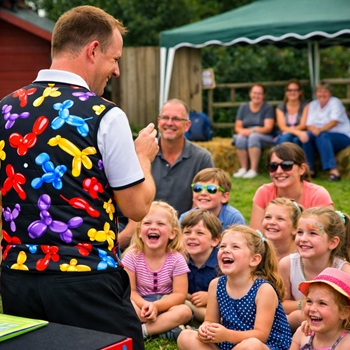
Planning a children’s party well isn’t complicated, but the order you do things in makes a real difference to how smoothly the day runs. Over years of performing at parties across Derbyshire and the Midlands, I’ve seen what separates a party that flows from one that feels rushed or flat. Most of it comes down to a handful of decisions made weeks before the day itself: booking order, room size, and timing between food and entertainment. This guide walks through those decisions so you can plan with confidence, whatever size or style of party you’re hosting.
If you're still looking for a professional entertainer, have a look at my Children's Party Packages to see exactly what is included and choose the option that best suits your celebration.
If you're planning your first children's birthday party, don't worry—thousands of parents have been in exactly the same position. With a little planning and a few simple tips, organising a fun, relaxed celebration is much easier than you might think. Getting the Order Right
Book your entertainer before you confirm the venue. A hall has several time slots available on any given Saturday — a specific entertainer doesn't. If you fall in love with a venue first and then find your preferred entertainer is already booked that day, you're stuck compromising on the part of the day the children will remember most. Lock in the entertainment, then build the venue and guest list around that time slot.
Before booking, it's worth checking real reviews from local parents so you know you're choosing someone with a proven track record. Top Tip
Weekend dates between April and September are often booked several months in advance.
Choosing the Right Size Room
Bigger isn't automatically better. A room that's too large for the group swallows the energy — children spread out, the entertainer has to project across a bigger gap, and the party can feel flat even when everyone's having fun. A room that's too small leaves no space for party games or a clear "stage end" for the show.
As a rough guide:
Up to 15 children: a standard living room or small hall room works fine
15–20 children: a medium village hall room gives you space for both a show area and a games area
20–30 children: you'll want a larger hall with a proper separation between the entertainment zone and the food/tables area
When you're viewing a hall, consider whether the room can be split or arranged into a "show end" and a "party end" — it makes the transition between activities much smoother.
Timing: Entertainment Before Food
Always have the entertainment before the food, not after. Children who've just eaten cake and squash are naturally lower-energy and harder to re-engage — trying to do an interactive magic show to a room of children mid-food-coma is an uphill battle for everyone. The energy curve of a good party looks like this:
Arrival & mingling (10 mins)
Entertainment — magic show (45–60 mins)
Food, cake, balloon modelling (20–30 mins)
Games (15–30 mins)
The above structure fits comfortably into a full two-hour party booking.
How Long Should the Entertainment Run?
For most birthday parties, a 45–60 minute show is the sweet spot. Younger children (under 5) tend to do better nearer the 45-minute mark; a mixed-age group of 5–8-year-olds can happily sustain a full hour, especially when it includes audience participation rather than just watching.
If you're unsure which party length is best, this guide explains the difference between my 1-hour and 2-hour children's party packages.
Always tell guests to arrive 10 - 15 minutes early before the entertainment starts. What to Check Before You Book a Venue
Kitchen access — most village and community halls in Derbyshire and the Midlands area have some kitchen facilities, but it varies a lot. Ask specifically what's available - will you need a fridge ? - rather than assuming.
Parking and loading access — especially important for an entertainer to unload and parents to park.
Ceiling height, if you're planning a bouncy castle alongside any entertainment.
Public liability insurance and DBS checks — any entertainer you book for a children's event should be able to show you both without being asked twice.
If you're holding your celebration in a village hall or community centre, my children's party entertainment is fully self-contained with professional sound equipment and everything needed for the show.
Here are some local village halls and venues you coul look at. Planning a Garden or Outdoor Party
Garden parties bring a different set of questions to think through. A few things worth sorting out well ahead of the day:
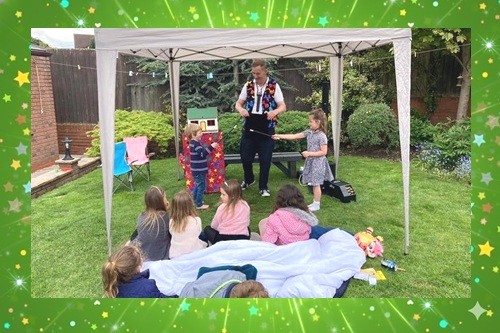
Have a wet-weather backup plan. A gazebo or marquee is worth arranging in advance rather than as a last-minute scramble if rain looks likely — and it's worth checking whether your garden or the wider space has any indoor fallback (a garage, conservatory, or nearby hall) in case the weather turns bad.
Shade matters as much as rain. On a hot day, a shaded area for younger children and for the entertainment itself makes a real difference — direct sun for an hour is tiring for children and can make a magic show harder to watch clearly too.
Power access. If there's music, a microphone, or any sound equipment involved, check where the nearest outdoor socket is, or whether an extension lead reaching from the house will be needed.
Ground surface. A flat, dry patch of lawn or a patio area works far better than an uneven or sloped garden for games and for any equipment.
Consider where you are going to put the party food as even a slight breeze can send party plates and cups flying.
Don't Forget the Photos
One of the highlights of any children's party is capturing those special memories, especially with the birthday child, family and friends. Every party provides plenty of opportunities for great pictures, and you can see examples from real parties I've performed at by visiting my Party Photo Gallery. A Rough Guide to Budgeting
Every family's priorities are different, but as a general pattern, most parents find their spend splits roughly across three areas: the venue hire (if not hosting at home), food and cake, and the entertainment itself. Entertainment is often the piece families are tempted to trim first to save money, but it's worth remembering it's usually the single biggest driver of how much fun the children actually have — a lovely venue and spread of food won't carry a party on their own if there's a gap in the middle where nothing much is happening. A sensible approach is to decide on the entertainment first, then fit the venue and catering budget around what's left.
Once you've chosen a date, it's a good idea to check my availability before sending invitations. Most Common Children's Party Mistakes
- Inviting too many children.
- Starting too late.
- Serving food before everyone arrives.
- Booking the venue that's too small.
- Forgetting parking information.
- Not leaving space for the magic show.
- Waiting until the last minute to book entertainment.
A Few Questions Parents Often Ask
What if a child doesn't want to join in?
A good entertainer will never force participation — shy children are usually drawn in gradually, or perfectly happy to watch, and that's fine.
How far in advance should I book?
Weekends in the run-up to Christmas and over the summer holidays get booked up months ahead — for a Saturday or Sunday in a peak period, 2–3 months' notice is a sensible minimum.
Do I need to provide anything for the entertainer?
A small clear space and access to a power socket is usually all that’s required. Most professional entertainers arrive fully self-contained.
What age group works best for a magic show and games?
Most children’s entertainers are strongest with the 4–8 age range, where the mix of magic, games and balloon modelling keeps everyone engaged. Younger children (3–4) still enjoy it if the show is kept closer to 45 minutes - 1 hour
You may also find answers on my dedicated Children's Party FAQ page. This guide is based on years of performing at children's parties across Derby and the Midlands. If you're planning a party and looking for entertainment, get in touch — I'm happy to help you think through timing even before you've settled on a date.
Hopefully this guide has helped you plan the perfect children's party. If you're looking for an experienced Derby children's entertainer who can take the stress out of the day, I'd love to help. So if you're planning a party and want to check date availability, take a look at my Party Packages & Prices or get in touch for a quick quote.